
A French omelette is the quiet opposite of the big diner-style omelette: three eggs, a knob of butter and a pinch of salt, cooked gently and quickly so the outside stays smooth and pale with no browning, and the inside soft and creamy. The French call that centre baveuse, and it is the whole point. This French omelette recipe makes one omelette in about 10 minutes. It works because the eggs are kept moving over a medium-low heat, so they set in tiny curds rather than one tough sheet, and you stop just before they are done.
| Preparation | 5 minutes |
|---|---|
| Cooking | 5 minutes |
| Total | about 10 minutes |
| Servings | 1 (one 3-egg omelette) |
| Difficulty | Medium – the timing takes a little practice |
| What you need | 20 cm non-stick frying pan, bowl, fork, silicone spatula, warm plate |
Ingredients
- 3 large eggs, at room temperature
- 15 g unsalted butter, plus a small knob to finish
- ¼ tsp fine salt
- 1 tbsp finely snipped chives (optional)
- 30 g soft cheese, such as fresh goat's cheese or cream cheese (optional filling)
- freshly ground black pepper, to serve
How to make a French omelette
- Beat the eggs. Crack the eggs into a bowl, add the salt and beat them with a fork for about 30 seconds, until the whites and yolks are completely blended and no streaks remain. Keep the mixture smooth rather than frothy: air bubbles make the omelette dry and spongy. Stir in half the chives, if using, and put a plate to warm.
- Heat the pan. Set a 20 cm non-stick frying pan over a medium-low heat for a minute, then add the butter and swirl it around the base and up the sides. It should melt and foam gently; if it browns or smells nutty, the pan is too hot, so lift it off the heat for a few seconds.
- Stir and shake. As soon as the foam settles, pour in the eggs. Straight away start shaking the pan back and forth with one hand while stirring the eggs in small circles with a silicone spatula with the other, scraping the whole base. Keep going for 30–60 seconds, until the eggs look like loose, soft curds with only a little liquid left between them.
- Set the base. Stop stirring and smooth the surface level with the spatula. Let the omelette cook undisturbed for 10–20 seconds, just long enough for a thin skin to form underneath while the top stays glossy and slightly wet. If you are filling the omelette, spoon the soft cheese in a line across the middle now.
- Roll it up. Take the pan off the heat and tilt it away from you. Fold the third nearest the handle over the middle with the spatula, then tap the handle gently so the omelette slides to the far edge and the far lip curls up. Hold the warm plate against the lip of the pan and turn the pan over so the omelette rolls out onto the plate, seam side down.
- Finish and serve. Tuck in any loose edges with the spatula to make a neat oval. Rub the top with the small knob of butter for a soft shine, scatter over the rest of the chives and a little black pepper, and eat it straight away: a French omelette waits for no one.
What to cook a French omelette in
More than any other egg dish, a French omelette is about the pan. Three eggs need a base of about 20 cm: in a larger pan they set before you can roll them, in a smaller one the omelette is too thick to cook through without colouring. It must be non-stick, because you stir constantly and then need the omelette to slide out whole, and light enough to shake with one hand. Browse the pans we have picked out for eggs and omelettes, or go straight to our 20 cm pans.
A 20 cm non-stick pan for the classic three-egg omelette
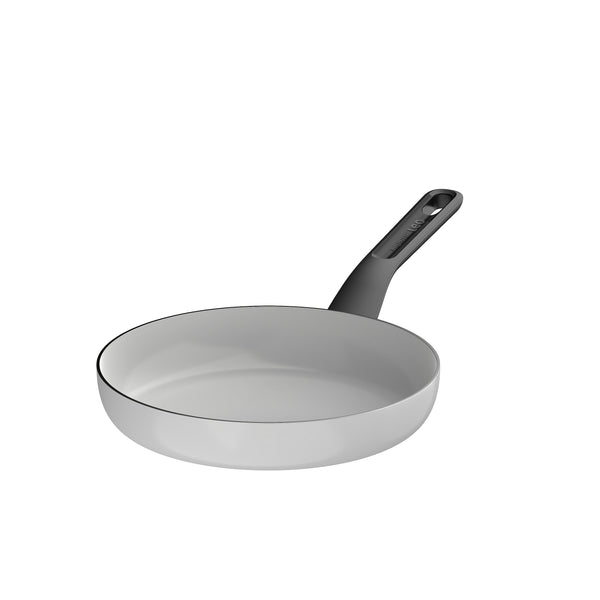
The Graphite Non-stick Frying Pan 20 cm is the size this recipe is written for: 20 cm across inside with 4 cm sides. Its recycled aluminium body and full disk base conduct heat fast and evenly, so no hot spot browns the middle before the edges have set, and the CeraGreen ceramic non-stick coating, PFAS-free according to the manufacturer, lets the omelette glide onto the plate. It is light to shake, works on all hobs including induction, is ovenproof up to 230 °C, and the manufacturer recommends washing it by hand. Other coatings and sizes are in our non-stick pans.
An omelette pan for two
If you would rather make one larger omelette for two, the Graphite Non-stick Omelette Pan 25 cm has the same body, base and CeraGreen coating, PFAS-free according to the manufacturer, but a wider 25 cm base and a low 2 cm rim, so a five-egg omelette cooks evenly and slides out without catching. It also suits all hobs including induction and is ovenproof up to 230 °C.
Not sure which diameter your kitchen is missing? Our guide Frying pan sizes: 20, 24, 28 or 32 cm – which one do you need? explains what each size is for, and to complete your kitchen in one go, our frying pan sets pair a small egg pan with the larger everyday sizes.
Tips and common mistakes
- Brown, leathery outside. The heat was too high. The butter should foam softly, never sizzle hard; if it browns, wipe the pan out and start again.
- Rubbery, dry centre. You stirred too long or waited too long before rolling. Take the pan off the heat while the top still looks wet; the omelette finishes cooking in its own heat on the plate.
- It tears when you roll it. The base skin had not formed, or the spatula is too stiff. Give it the full 10–20 seconds undisturbed and use a soft silicone spatula that follows the curve of the pan.
- Cold eggs, uneven cooking. Eggs straight from the fridge cool the pan and set unevenly. Take them out of the fridge 20–30 minutes earlier.
Variations
Omelette aux fines herbes
The classic herb version uses a tablespoon of mixed chopped chives, chervil, flat-leaf parsley and a little tarragon, most of it stirred into the eggs and a pinch kept for the top. Tarragon is strong, so use half as much of it as of the others.
With soft cheese
Fresh goat's cheese, cream cheese or a spoonful of crème fraîche down the middle just before rolling melts gently into the creamy centre; keep it to about 30 g or the omelette will not close. Any other filling should be cooked and warm before the eggs go in, because cold, wet fillings make the omelette soggy.
Making it for two
A French omelette is a one-person dish, so for two people make two in a row: beat 6 eggs with ½ tsp salt, pour half into the pan each time and use a fresh 15 g of butter for the second. The first waits happily under a plate for the two minutes the second takes. For a single larger omelette, use 5 eggs and a 25 cm omelette pan and expect a flatter, more folded shape.
What to serve with a French omelette
At breakfast or brunch, a French omelette needs little more than good bread and butter, a few leaves of dressed salad and a cup of coffee; for a light supper, add boiled new potatoes or sautéed mushrooms. It is a natural second egg dish once you have shakshuka in your repertoire, and at the weekend the same pan will turn out a stack of American pancakes. Once you are confident with eggs over gentle heat, spaghetti carbonara, where the yolks thicken into a sauce off the hob, is the next step.
French omelette FAQ
What is the difference between a French omelette and an ordinary omelette?
A French omelette is cooked over a medium-low heat, stirred until it forms soft curds and then rolled, so it is pale, smooth and creamy inside. An ordinary omelette is cooked over a higher heat without stirring until the base is golden, then filled and folded in half, giving a firmer, drier texture.
Why is my omelette rubbery?
Too much heat for too long. Eggs tighten and squeeze out moisture as they get hotter, so a high flame or an extra minute on the hob gives a tough, weeping omelette. Keep the heat medium-low, keep the eggs moving and stop while the top is still glossy.
What is the best pan for a French omelette?
A light 20 cm non-stick frying pan with gently sloping sides: the size gives a three-egg omelette the right thickness, the coating lets you stir and roll without the eggs catching, and a light pan is easy to shake. For four or five eggs choose a 24–25 cm pan, ideally an omelette pan with a low rim.
The photo is illustrative (AI-generated).